PHP vs IOP: Which Outpatient Program is Right for You?
If you’re comparing PHP vs IOP treatment programs, you’re making an important decision about your addiction recovery. Understanding the difference between partial hospitalization programs (PHP) and intensive outpatient programs (IOP) is crucial for choosing the level of care that will give you the best chance at lasting sobriety. At Sanative Recovery in Blue Ash, Ohio, we offer both PHP and IOP programs, and we help individuals determine which program fits their unique situation. This comprehensive guide explains the PHP vs IOP comparison in detail, including schedules, intensity, costs, and how to decide which program is right for your recovery journey.
Understanding PHP vs IOP: The Basics
The PHP vs IOP decision represents choosing between two different levels of outpatient addiction treatment. Both programs allow you to live at home while receiving professional care, but they differ significantly in intensity and time commitment.
What is PHP (Partial Hospitalization Program)?
A Partial Hospitalization Program (PHP) is the most intensive level of outpatient care. According to SAMHSA, PHP provides structured, daily treatment while allowing patients to return home at night. In the PHP vs IOP comparison, PHP offers:
- Higher intensity: More hours of treatment per day
- Structured daily schedule: Typically 5-6 days per week
- Comprehensive programming: Individual therapy, group counseling, medication management, and skill-building
- Medical supervision: Regular monitoring by healthcare professionals
- Step-down from detox or inpatient: Often the first level of care after medical detoxification
At Sanative Recovery, our PHP program runs Monday through Friday from 8:30 AM to approximately noon, providing intensive evidence-based treatment in a condensed timeframe that respects your need to maintain some daily responsibilities.
What is IOP (Intensive Outpatient Program)?
An Intensive Outpatient Program (IOP) provides structured addiction treatment with more flexibility than PHP. In the PHP vs IOP debate, IOP is characterized by:
- Moderate intensity: Fewer hours per week than PHP
- Flexible scheduling: Often evening or part-day sessions
- Work-life balance: Designed to accommodate work, school, or family responsibilities
- Continuing care focus: Typically used after completing PHP or as a step-up from traditional outpatient
- Real-world application: Practice recovery skills while managing daily life
PHP vs IOP: Side-by-Side Comparison
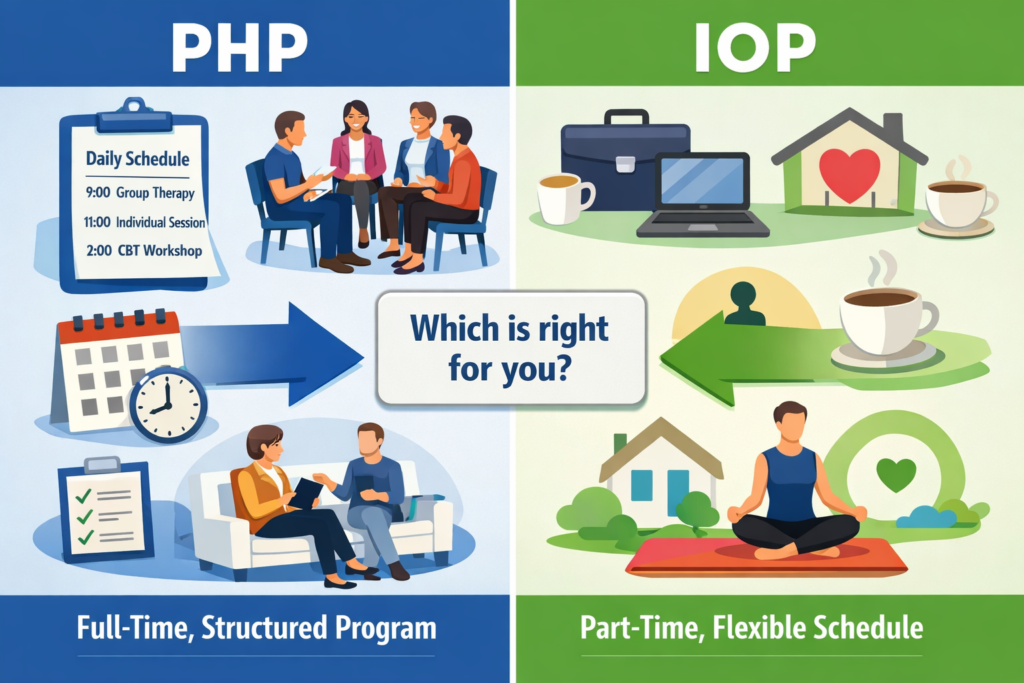
Understanding the PHP vs IOP differences helps you make an informed treatment decision. Here’s a detailed comparison:
Time Commitment: PHP vs IOP
PHP (Partial Hospitalization Program):
- 20-30 hours per week total
- Typically 5-6 days per week
- 4-6 hours per day
- Full weekday commitment
- At Sanative Recovery: Monday-Friday, 8:30 AM – 12:00 PM (condensed morning schedule)
IOP (Intensive Outpatient Program):
- 9-15 hours per week total
- Typically 3-5 days per week
- 2-4 hours per session
- Flexible day/evening options
- Allows for work or school attendance
In the PHP vs IOP time commitment comparison, PHP requires significantly more weekly hours, making it more intensive but potentially shorter in total duration.
Treatment Intensity: PHP vs IOP
PHP Intensity:
- Highly structured daily programming
- Multiple therapy sessions daily
- Frequent individual counseling
- Extensive group therapy
- Medical monitoring and medication management
- Psychiatry services when needed
- Daily check-ins and assessments
IOP Intensity:
- Structured but less intensive
- Regular therapy sessions (not daily)
- Weekly individual counseling
- Group therapy focus
- Periodic medication check-ins
- Less frequent medical supervision
The PHP vs IOP intensity difference reflects where you are in recovery. PHP provides immersive treatment for early recovery or more severe addiction, while IOP offers substantial support while transitioning back to normal life.
Treatment Components: PHP vs IOP
Both PHP and IOP programs include evidence-based therapies, but the frequency and intensity differ:
PHP Components:
- Daily individual therapy or frequent sessions
- Multiple group therapy sessions daily
- Family therapy and education
- Cognitive Behavioral Therapy (CBT)
- Dialectical Behavioral Therapy (DBT)
- Relapse prevention training
- Medication-assisted treatment (MAT) coordination
- Life skills development
- Trauma-focused therapy
- Mindfulness and meditation
- Nutritional counseling
- Wellness activities
IOP Components:
- Weekly or bi-weekly individual therapy
- Regular group therapy sessions
- Family therapy as needed
- CBT and other evidence-based therapies
- Relapse prevention focus
- MAT support and coordination
- Recovery skills practice
- Support group integration
At Sanative Recovery, both our PHP and IOP programs incorporate the same high-quality, evidence-based therapies. The difference in the PHP vs IOP comparison is the frequency and intensity, not the quality of care.
Cost Comparison: PHP vs IOP
When evaluating PHP vs IOP, cost is an important consideration:
PHP Costs:
- Generally more expensive due to intensive nature
- Higher staff-to-patient ratio
- More therapeutic hours included
- Typically covered by insurance as medically necessary
- Out-of-network benefits often 50-70% coverage
IOP Costs:
- Less expensive than PHP
- Lower weekly cost due to fewer hours
- Also covered by most insurance plans
- More affordable for self-pay patients
Important note: At Sanative Recovery, we’re an out-of-network provider, which means we’re not restricted by insurance company treatment limitations. We provide the care you need based on clinical judgment, not what insurance dictates. We help maximize your out-of-network benefits and create manageable payment arrangements because we believe money should never prevent access to quality treatment.
PHP vs IOP: Who Needs Which Program?
Determining whether you need PHP vs IOP depends on several factors related to your addiction severity, life circumstances, and treatment history.
You May Need PHP If You:
- Just completed medical detox: PHP is typically the appropriate step-down from detoxification
- Have severe addiction: Long-term, heavy substance use often requires PHP-level intensity
- Experienced relapse in IOP or outpatient: Need to step up to more intensive care
- Have co-occurring mental health conditions: Dual diagnosis often benefits from PHP’s comprehensive approach
- Lack stable home environment: PHP provides structure when home support is limited
- Need medical monitoring: Ongoing health concerns require frequent supervision
- Are at high risk for relapse: Severe cravings or triggers necessitate daily support
- Had multiple previous treatment attempts: History of unsuccessful treatment suggests need for higher intensity
- Can dedicate full days to treatment: Able to pause work/school temporarily for recovery
You May Need IOP If You:
- Completed PHP successfully: Ready to step down but still need substantial support
- Have mild to moderate addiction: Substance use disorder that doesn’t require PHP intensity
- Have strong home support system: Family/friends actively supporting recovery
- Must maintain work or school: Cannot take time away from employment or education
- Have childcare or family responsibilities: Need flexibility for caregiving duties
- Completed inpatient or residential: Transitioning from 24/7 care but not ready for minimal support
- Are motivated and stable: Demonstrated ability to maintain sobriety with less structure
- Need continuing care: Maintaining recovery after completing higher levels of care
- Have stable living situation: Safe, supportive home environment
PHP vs IOP: Real-World Schedule Comparison
Understanding what a typical day looks like helps clarify the PHP vs IOP decision. Here’s what you can expect at Sanative Recovery:
Typical PHP Day at Sanative Recovery
8:30 AM – Morning Meditation and Goal Setting
Begin the day with mindfulness practice and intention-setting
9:00 AM – Clinical Process Group
Share feelings, discuss challenges, and receive peer support in facilitated therapeutic discussion
10:00 AM – Educational/Skill-Building Group
Rotating topics throughout the week:
- Monday: Disease Model of Addiction
- Tuesday: Relapse Prevention
- Wednesday: Dialectical Behavioral Therapy (DBT)
- Thursday: Grief & Loss
- Friday: Relapse Prevention Plan Development
11:00 AM – Therapeutic Skills Group
Evidence-based therapy approaches:
- Monday: Cognitive Behavioral Therapy (CBT) – Cognitive Reframing
- Tuesday: Family Dynamics
- Wednesday: Communication Skills
- Thursday: Healthy Relationships in Recovery
- Friday: Anger Management
12:00 PM – Conclusion
Program ends, allowing you to handle afternoon responsibilities, attend individual therapy appointments, or practice recovery skills in real-world settings
This condensed morning schedule distinguishes Sanative Recovery in the PHP vs IOP comparison. We provide full PHP-level intensity in fewer hours, maximizing treatment effectiveness while respecting your need for flexibility.
Typical IOP Schedule
IOP schedules are more flexible and typically include:
Evening IOP Option:
- Monday, Wednesday, Friday: 6:00 PM – 9:00 PM
- Group therapy, individual sessions scheduled separately
- Allows full-time work or school attendance
Day IOP Option:
- Tuesday, Thursday: 9:00 AM – 1:00 PM
- Saturday: 9:00 AM – 12:00 PM
- Accommodates part-time work or non-traditional schedules
The PHP vs IOP schedule difference is clear: PHP requires daily commitment during business hours, while IOP offers part-time programming that fits around other obligations.
The PHP vs IOP Decision: Assessment Criteria
Healthcare professionals use specific criteria to determine appropriate placement in the PHP vs IOP comparison. The American Society of Addiction Medicine (ASAM) criteria evaluate six dimensions:
1. Acute Intoxication and Withdrawal Potential
- PHP: May be appropriate immediately post-detox when withdrawal risks remain
- IOP: Suitable when medically stable with no acute withdrawal concerns
2. Biomedical Conditions and Complications
- PHP: Can accommodate co-occurring medical conditions requiring monitoring
- IOP: Appropriate when medical conditions are stable and managed
3. Emotional, Behavioral, or Cognitive Conditions
- PHP: Necessary for severe mental health conditions requiring intensive intervention
- IOP: Works for stable mental health conditions or those responding to treatment
4. Readiness to Change
- PHP: Provides structure for those with ambivalence or low motivation
- IOP: Requires higher baseline motivation and commitment
5. Relapse, Continued Use, or Continued Problem Potential
- PHP: Addresses high relapse risk through daily structure and support
- IOP: Manages moderate relapse risk while building independence
6. Recovery Environment
- PHP: Compensates for unsupportive or high-risk living situations
- IOP: Leverages stable, supportive home environments
At Sanative Recovery, we conduct comprehensive assessments using these criteria to help determine whether PHP vs IOP is appropriate for your situation.
PHP vs IOP: Treatment Outcomes and Success Rates
Research on PHP vs IOP outcomes shows that both programs can be highly effective when matched to appropriate patient needs:
PHP Outcomes
Studies show that PHP programs demonstrate:
- Completion rates of approximately 60-70% when patients are appropriately placed
- Significant reductions in substance use at program completion
- Improved mental health symptoms and functioning
- Strong outcomes for patients stepping down from inpatient care
- Effectiveness for dual diagnosis treatment
IOP Outcomes
Research indicates IOP achieves:
- Completion rates of 50-60% for appropriately matched patients
- Comparable long-term abstinence rates to PHP for lower-risk individuals
- Success in maintaining employment and family stability during treatment
- Effective relapse prevention when used as step-down care
- Strong outcomes for medication-assisted treatment support
The key finding in PHP vs IOP outcome research: appropriate matching matters more than the level of care itself. According to the National Institute on Drug Abuse, matching treatment intensity to patient needs produces the best results.
PHP vs IOP: Insurance Coverage and Costs
Understanding how insurance covers PHP vs IOP helps with financial planning:
Insurance Coverage for PHP
Most insurance plans cover PHP as it’s considered medically necessary treatment:
- Medical necessity: Typically approved post-detox or for severe addiction
- Prior authorization: Usually required before starting PHP
- In-network coverage: Often 80-90% after deductible
- Out-of-network coverage: Typically 50-70% (Sanative Recovery works to maximize these benefits)
- Duration limits: Many plans limit PHP to 2-4 weeks initially, with extensions requiring additional authorization
Insurance Coverage for IOP
IOP is also widely covered by insurance:
- Medical necessity: Approved for ongoing treatment or as step-down care
- Prior authorization: May or may not be required depending on plan
- In-network coverage: Often 80-90% after deductible
- Out-of-network coverage: Typically 50-70%
- Duration limits: Often allows 8-12 weeks, sometimes longer
Out-of-Network Benefits: The Sanative Recovery Advantage
As an out-of-network provider, Sanative Recovery offers important advantages in the PHP vs IOP consideration:
- Clinical independence: We determine treatment length based on your needs, not insurance restrictions
- No insurance-dictated protocols: Treatment is personalized, not cookie-cutter
- Extended care when needed: We can continue PHP or IOP as long as clinically appropriate
- Quality over quotas: Small census means individual attention, not high-volume processing
- Financial accessibility: We work with every client to maximize benefits and create payment plans
We help you verify benefits and understand your out-of-network coverage for both PHP vs IOP programs. Many clients are surprised to find that out-of-network benefits provide substantial coverage while preserving treatment quality and clinical independence.
Transitioning Between PHP and IOP
Understanding the PHP vs IOP transition process is important because many people move between levels of care:
Stepping Down from PHP to IOP
Most individuals start with PHP and transition to IOP as they progress. Indicators you’re ready to step down include:
- Stable sobriety: Consistent abstinence for several weeks
- Reduced cravings: Better ability to manage urges
- Improved coping skills: Successfully using recovery tools
- Mental health stability: Mood and psychiatric symptoms well-managed
- Strong recovery foundation: Engaged in support groups, therapy
- Safe living situation: Home environment supports recovery
- Treatment team recommendation: Clinical staff assess readiness
At Sanative Recovery, we coordinate seamless transitions from PHP to IOP, ensuring continuity of care with the same therapeutic team who knows your story.
Stepping Up from IOP to PHP
Sometimes individuals need to increase treatment intensity. Signs you may need to step up from IOP to PHP include:
- Relapse or continued use: Unable to maintain abstinence in IOP
- Intensified cravings: Urges becoming unmanageable
- Mental health deterioration: Depression, anxiety, or other symptoms worsening
- Life stressors: Major changes overwhelming coping skills
- Increased relapse risk: Recognizing you need more support
- Poor IOP engagement: Missing sessions, not participating fully
Stepping up to PHP isn’t a failure—it’s a smart clinical decision that can prevent full relapse and preserve your recovery progress.
PHP vs IOP: What Makes Sanative Recovery Different
When comparing PHP vs IOP programs, what makes Sanative Recovery stand out in Blue Ash, Ohio?
Condensed Morning Schedule
Our PHP program runs 8:30 AM – 12:00 PM instead of all-day programming. This provides:
- Full PHP-level intensity in condensed timeframe
- Afternoon availability for individual therapy, medical appointments, or family time
- Less disruption to work schedules (some clients work afternoons/evenings)
- More efficient use of treatment time
Small Census, Individual Attention
Unlike large corporate facilities:
- We maintain smaller group sizes
- Your therapist truly knows you and your story
- Personalized treatment plans, not assembly-line care
- You’re not lost in a crowd of 30+ patients
Out-of-Network Clinical Independence
Being out-of-network means:
- We make treatment decisions based on your needs, not insurance company mandates
- No pressure to discharge before you’re ready
- Flexibility to extend PHP or continue IOP as long as beneficial
- Quality care over volume-based models
Evidence-Based Programming
Both our PHP and IOP include:
- Cognitive Behavioral Therapy (CBT)
- Dialectical Behavioral Therapy (DBT)
- Relapse prevention training
- Family therapy and education
- Trauma-informed care
- Mindfulness and meditation
- Medication-assisted treatment coordination
Financial Accessibility
We believe money should never prevent access to quality care:
- We work with every client to create manageable payment arrangements
- Help maximize out-of-network insurance benefits
- Flexible payment plans available
- No one is turned away due to inability to pay
PHP vs IOP: Making Your Decision
If you’re struggling with the PHP vs IOP choice, here’s a practical decision-making framework:
Step 1: Get Professional Assessment
Don’t self-diagnose your treatment needs. Contact Sanative Recovery for a comprehensive assessment. We’ll evaluate:
- Addiction severity and substance use history
- Mental health conditions
- Previous treatment history
- Medical conditions
- Home environment and support system
- Work/school/family obligations
Step 2: Consider Your Current Situation
Ask yourself honestly:
- Am I coming directly from detox? (Usually indicates PHP)
- Can I stay sober with current support level? (If no, may need PHP)
- Do I have a safe, supportive living situation? (Important for IOP success)
- Can I commit to daily programming? (Required for PHP)
- Do I need to maintain employment? (May indicate IOP, but some manage PHP)
Step 3: Verify Insurance Coverage
Understand your benefits for both PHP vs IOP:
- Call Sanative Recovery – we’ll verify your benefits for you
- Understand out-of-network coverage percentages
- Know your deductible and out-of-pocket maximum
- Ask about prior authorization requirements
- Discuss payment plans if needed
Step 4: Trust Clinical Recommendations
If professionals recommend PHP but you want IOP (or vice versa):
- Ask why they’re making that recommendation
- Understand the risks of choosing a different level
- Remember: starting at appropriate intensity prevents relapse
- You can always step down from PHP to IOP as you progress
PHP vs IOP: Frequently Asked Questions
Can I work while in PHP?
PHP typically requires 20-30 hours per week, making full-time work difficult. However, some people manage part-time work, especially with evening or weekend jobs. At Sanative Recovery, our morning-only PHP schedule (8:30 AM – noon) allows some clients to work afternoon or evening shifts. Discuss your specific situation with our admissions team.
How long do PHP and IOP last?
PHP typically lasts 2-6 weeks, though some individuals need longer. IOP usually runs 8-12 weeks or more. Duration depends on individual progress, clinical needs, and insurance coverage. At Sanative Recovery, we extend treatment as long as clinically appropriate, not based on arbitrary insurance timelines.
Is PHP or IOP better for dual diagnosis?
Both PHP and IOP can effectively treat co-occurring disorders (dual diagnosis). PHP is often recommended initially due to the intensive mental health treatment needed, with transition to IOP as symptoms stabilize. The best choice depends on symptom severity and treatment response.
What happens if I relapse in IOP?
Relapse in IOP doesn’t mean you’ve failed—it indicates you may need more intensive support. Options include stepping up to PHP, increasing IOP frequency, or adding individual therapy. The key is being honest about relapse so your treatment team can adjust your plan.
Can I go straight to IOP without PHP?
Yes, if appropriate. IOP can be the starting point if you have mild-to-moderate addiction, strong support systems, and stable mental health. Many people successfully complete IOP without needing PHP. Professional assessment determines the right starting point.
Does insurance cover PHP and IOP differently?
Most insurance plans cover both, but may have different authorization requirements or duration limits. PHP often requires more extensive prior authorization due to higher cost. Contact Sanative Recovery and we’ll verify your specific coverage for both PHP vs IOP.
Life After PHP and IOP: Continuing Care
Whether you complete PHP, IOP, or both, ongoing support is essential for maintaining recovery:
Step-Down Care Options
- Traditional outpatient therapy: Weekly or bi-weekly individual counseling
- Medication management: Ongoing MAT or psychiatric medication monitoring
- Support groups: AA, NA, SMART Recovery, or other mutual aid groups
- Alumni programs: Continued connection with treatment community
- Sober living: Structured housing if home environment is challenging
Relapse Prevention Planning
Both PHP and IOP emphasize creating comprehensive relapse prevention plans including:
- Identifying personal triggers and high-risk situations
- Developing specific coping strategies
- Building a support network
- Creating emergency action plans
- Establishing healthy routines and lifestyle
- Planning for ongoing therapy and support
Conclusion: PHP vs IOP Decision
The PHP vs IOP comparison isn’t about which program is “better”—it’s about which level of care matches your current needs. PHP provides intensive, structured treatment ideal for early recovery, severe addiction, or stepping down from detox. IOP offers substantial support with flexibility for those maintaining sobriety while managing life responsibilities or transitioning from higher levels of care.
At Sanative Recovery in Blue Ash, Ohio, we offer both PHP and IOP programs with evidence-based treatment, individual attention, and clinical independence. Our morning-focused schedule provides full treatment intensity while respecting your need for flexibility. We work with every client to determine the appropriate level of care and create manageable payment arrangements.
The most important decision isn’t PHP vs IOP—it’s choosing to get help. Whether you need partial hospitalization or intensive outpatient treatment, we’re here to support your recovery journey. Contact Sanative Recovery today for a free assessment to determine which program is right for you. Recovery is possible, and it starts with taking that first step.
About Sanative Recovery and Wellness
Sanative Recovery and Wellness is a substance use disorder treatment facility in Blue Ash, Ohio, offering both Partial Hospitalization Programs (PHP) and Intensive Outpatient Programs (IOP) for individuals recovering from addiction. Our evidence-based treatment approach includes Cognitive Behavioral Therapy, Dialectical Behavioral Therapy, relapse prevention, family therapy, and medication-assisted treatment coordination. As an out-of-network provider, we maintain clinical independence to provide treatment based on your needs rather than insurance company restrictions. Our condensed morning schedule (8:30 AM – noon for PHP) provides intensive care while allowing afternoon flexibility. We believe money should never prevent access to quality treatment and work with every client to maximize insurance benefits and create manageable payment arrangements. To learn more about our PHP and IOP programs or to schedule a free assessment, visit sanativeohio.com or contact us today.